The Illusion of Busy: Why Activity Doesn’t Equal Growth
May 12, 2026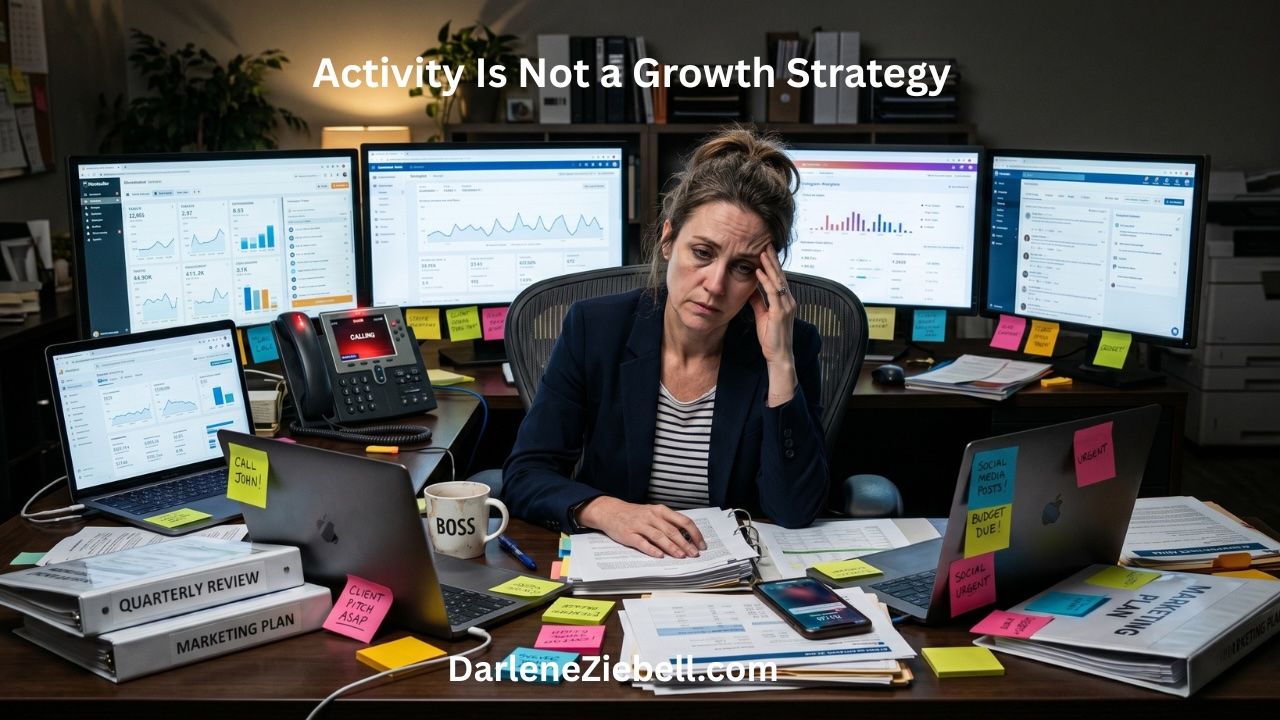
The Illusion of Busy: Why Activity Doesn’t Equal Growth
One of the most dangerous things I see in business today is the illusion of productivity. Business owners, executives, and entire leadership teams often believe that because they are constantly moving, constantly reacting, and constantly working, they must also be making progress. But after more than 30 years of building companies, advising entrepreneurs, and consulting with Fortune 1000 organizations, I can tell you that activity and growth are not the same thing.
Some of the busiest businesses I have ever seen were also some of the most financially unstable.
The modern business world rewards visible motion. Calendars packed with meetings make people feel important. Endless email chains create the impression of collaboration. Marketing dashboards filled with clicks, impressions, followers, and engagement numbers can make owners feel like momentum is building. Yet behind the scenes, sales may be flat, profits may be shrinking, operations may be disorganized, and leadership may be exhausted.
The problem is that many companies have become addicted to movement instead of measurable results.
I have watched entrepreneurs work twelve-hour days while unknowingly spending most of their time solving problems that should never have existed in the first place. I have also sat inside large corporate boardrooms with senior executives from Fortune 1000 companies who were trapped in the exact same cycle. Entire departments were consumed with reports, meetings, planning sessions, and internal presentations, yet very little of that activity translated into meaningful business growth.
Everyone looked busy. Very few people stopped to ask whether the business itself was actually becoming stronger.
This pattern is far more common than most people realize because activity feels productive. It gives people the emotional comfort that something important must be happening. Strategic thinking, on the other hand, is often quieter and less visible. Spending several hours evaluating whether a business model is still viable does not create the same immediate sense of accomplishment as attending six meetings or responding to one hundred emails. Yet one activity moves a company forward while the other may simply maintain chaos.
I see this issue constantly with business owners who believe their biggest challenge is marketing. They tell me they need more traffic, more social media engagement, more ads, more followers, or more leads. But once we begin examining the business closely, the real problems are often much deeper. In many cases, the company lacks operational structure, a clear market position, pricing strategy, scalable systems, or alignment between its marketing message and the actual value it delivers.
No amount of marketing activity can permanently fix structural business problems.
Over the years, I have had clients come to me after spending enormous amounts of money on marketing campaigns that produced very little measurable growth. In some situations, businesses had invested hundreds of thousands of dollars. In others, the marketing spend exceeded one million dollars. The reports looked impressive. The agencies showed charts, engagement numbers, website traffic, click-through rates, and social media analytics. On paper, it appeared that momentum was building.
But revenue growth was weak. Profits were disappointing. Customer retention was inconsistent. And leadership teams were frustrated because all the activity was not translating into sustainable business performance.
That is the danger of modern business metrics. Many owners are measuring movement instead of outcomes.
A company can have millions of views online and still struggle financially. It can generate thousands of leads while attracting the wrong customers. It can produce constant social media content while completely failing to differentiate itself in the marketplace. Visibility alone does not guarantee profitability.
Real growth is usually far less dramatic than people expect. In many cases, it comes from improving the underlying structure of the business itself. It comes from better leadership decisions, stronger operational systems, clearer positioning, smarter financial management, improved customer experience, and disciplined strategic planning. These are not always glamorous activities, but they are the foundation of companies that survive long term and scale successfully.
One of the reasons so many business owners become trapped in constant activity is because they are still operating as workers inside the company rather than leaders designing the future of the company. When businesses begin growing, owners often become overwhelmed by the increasing complexity of operations. More employees create more management challenges. More customers create more service demands. More sales channels create more coordination issues. Eventually, the business begins consuming the owner instead of supporting the owner’s vision.
At that point, many leaders stop thinking strategically because they are buried in day-to-day survival.
This is where burnout often begins. Leaders become mentally exhausted from making nonstop decisions and reacting to constant demands. The business starts operating in permanent response mode rather than intentional direction. Over time, this creates inefficiency throughout the organization. Teams become unclear about priorities. Meetings multiply. Communication becomes fragmented. Resources are wasted. Employees stay busy but often work on the wrong things.
Meanwhile, the owner keeps pushing harder, believing the answer must be more effort.
In reality, the answer is often clarity.
One of the first things I do when working with clients is help them identify which activities actually contribute to measurable growth and which activities simply consume time and energy. We examine where leadership attention is going, whether operational systems support scaling, whether the marketing strategy aligns with the business model, and whether the company structure itself is creating unnecessary friction.
Sometimes the greatest breakthroughs come not from adding more activity, but from eliminating the wrong activity altogether.
That can be difficult for ambitious entrepreneurs to accept because hard-working business owners often believe they should always be doing more. But growth at higher levels usually requires a different mindset. Scaling a company to seven or eight figures is rarely accomplished by working longer hours alone. It requires building systems, developing leadership capacity, creating operational discipline, and focusing intensely on measurable outcomes rather than appearances.
This also directly impacts the long-term value of a business. Buyers and investors are not impressed by companies that rely entirely on exhausted owners holding everything together through constant personal effort. Businesses that cannot operate efficiently without the founder are often viewed as risky and difficult to scale. Strong valuation comes from structure, stability, systems, profitability, and leadership depth.
That is why I often tell business owners to stop asking how busy they are and start asking whether the business itself is becoming stronger.
Are profits improving?
Is the company becoming more scalable?
Are operations becoming more efficient?
Is leadership becoming more effective?
Is customer quality improving?
Is the business building long-term enterprise value?
Those are the questions that matter.
Because at the end of the day, business growth is not created by motion alone. It is created by clarity, discipline, strategy, and leadership. And if a business feels harder to run than it should, there is often a deeper issue beneath the surface that no amount of activity will solve.
If your company feels stuck in constant motion without measurable progress, it may be time to stop focusing on being busy and start focusing on what is actually driving growth. You can learn more about working with Darlene M. Ziebell at DarleneZiebell.com.
Written by Darlene M. Ziebell
Ready to Take a Closer Look at Your Business?
Reading about business challenges is one thing. Identifying what may be holding back your own company is another.
If you're working through a growth challenge, preparing for the next stage of your business, or simply want an experienced outside perspective, let's talk.