Your 2027 Business Plan Should Start With What Went Wrong in 2026
Nov 01, 2026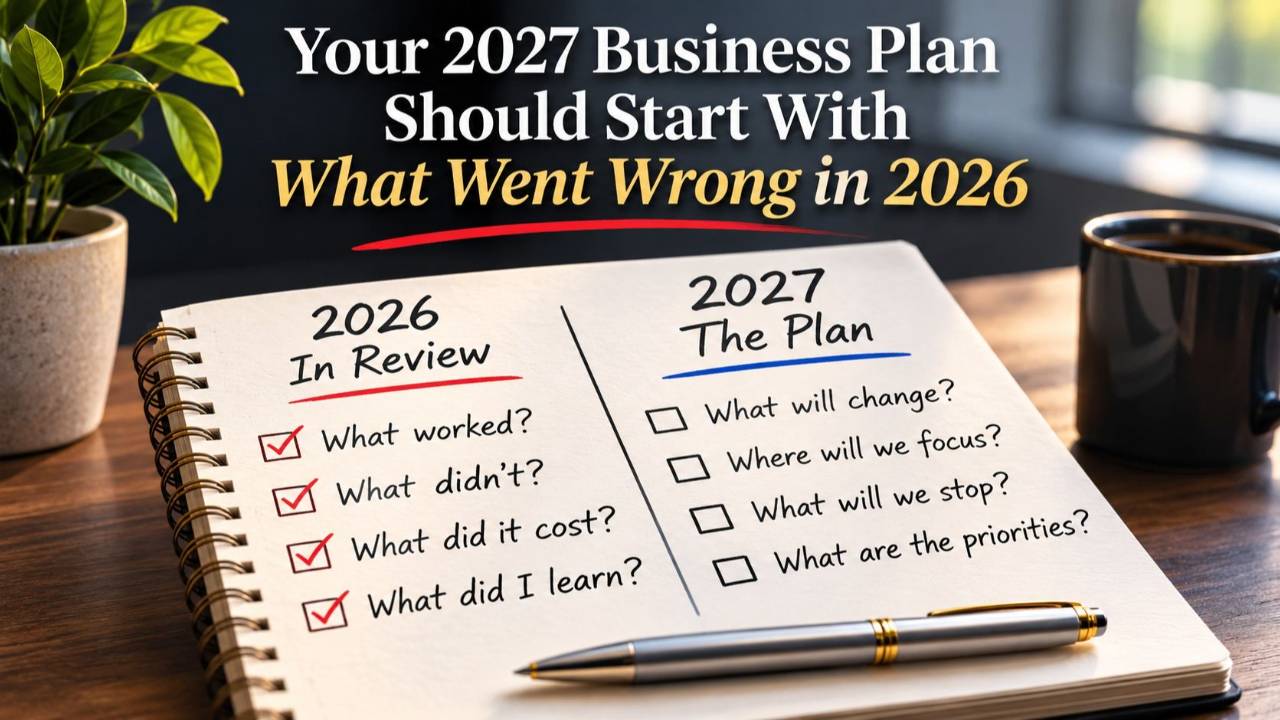
Your 2027 Business Plan Should Start With What Went Wrong in 2026
Before you set next year's revenue goals, take a hard look at what this year taught you.
It's November. Business owners are beginning to think about 2027. Some are already setting revenue targets, developing marketing budgets, considering new hires, or planning expansion.
But before you start planning for another year of growth, I have a question:
What went wrong in your business in 2026, and what are you going to do differently?
I've spent more than 30 years building businesses, including four of my own, and advising other business owners. One thing I've learned is that business growth doesn't come from setting bigger goals. It comes from understanding what's preventing you from reaching them.
Too often, owners build their next annual plan around what they hope will happen instead of what their financial performance, customers, employees, and operations are telling them.
And that's how the same problems follow them into another year.
Revenue Growth Doesn't Always Mean Business Success
Let's say your business generated $1.2 million in revenue this year, up from $1 million in 2025.
On paper, that's a 20% increase. Congratulations.
But what if your operating expenses increased 30%? What if you had to hire three additional employees, your cash reserves declined, and you worked more hours than the year before?
Did your business really improve?
Revenue is only one measurement of success.
I've seen businesses increase sales while simultaneously weakening their financial position. I've also seen owners make deliberate decisions to slow growth because their operations couldn't support additional demand.
Sometimes the smartest decision isn't to sell more. It's to fix what's happening behind the scenes.
Look at the Decisions That Didn't Work
Every business owner makes decisions that don't produce the expected results.
Maybe you invested in marketing that generated little return.
Perhaps you hired someone who wasn't qualified for the position.
You might have introduced a new product that customers didn't want, expanded too quickly, or continued serving unprofitable customers because you didn't want to lose the revenue.
These decisions cost money, time, and sometimes opportunities.
The important question isn't whether you made mistakes. Every successful entrepreneur has.
The question is whether you understand why those decisions didn't work and what you learned from them.
If you can't explain what went wrong, there's a good chance you'll repeat it.
Don't Confuse Activity With Progress
One of the biggest problems I see with established businesses is that everyone is busy, but the company isn't necessarily moving forward.
The owner is putting in long hours. Employees are working hard. Marketing campaigns are running. Customers are being served.
Yet profitability isn't improving, cash flow remains unpredictable, and the owner still makes nearly every important decision.
That's not necessarily growth. Sometimes it's just more work.
A business that depends entirely on its owner has a structural problem that additional sales won't automatically solve.
Before you decide how much you want to grow in 2027, ask whether your business can handle that growth without creating more problems.
Your 2027 Plan Needs More Than a Revenue Target
I frequently encounter business owners who tell me they want to double their revenue.
My response is usually to ask why.
What will doubling revenue accomplish? Will it improve profitability? Increase the company's value? Create more financial security? Position the business for a future sale?
Or will it simply create a larger, more complicated company that requires even more of the owner's time?
A revenue target without a strategy is just a number.
Your business plan should identify what needs to change, how those changes will be accomplished, who will be responsible, what resources are required, and how you'll measure progress.
It should also identify what you're going to stop doing.
Sometimes eliminating an unprofitable product, ineffective marketing channel, or unnecessary expense creates more value than adding another source of revenue.
Seven Questions to Answer Before Planning for 2027
Before you start developing next year's business plan, set aside some uninterrupted time and answer these questions. Be specific. Use actual financial results and business performance, not assumptions.
- What were my three biggest business disappointments in 2026?
Identify what didn't meet expectations. Was it revenue, profitability, employee performance, customer retention, marketing, or something else? More importantly, why did it happen?
- Did my business become more profitable, or did I simply generate more revenue?
Compare your gross margins, operating expenses, net profit, and cash flow with 2025. Where did your financial position improve, and where did it deteriorate?
- Which investments produced measurable results, and which ones didn't?
Examine your spending on marketing, technology, employees, consultants, equipment, and expansion. Can you identify a measurable return on those investments?
- What prevented my business from growing faster or operating more efficiently?
Was the obstacle insufficient demand, inadequate staffing, poor systems, limited capital, weak management, or your own availability?
- What am I still doing that someone else should be responsible for?
If you're involved in every operational decision, customer problem, and employee issue, how will your business grow without requiring even more of your time?
- If I could change only three things in my business in 2027, what would they be?
Don't create a list of 25 priorities. Identify the three changes most likely to improve profitability, operational performance, or long-term business value.
- What will happen if I don't change anything?
This may be the most important question of all. If you continue operating exactly as you did in 2026, where will your business be at the end of 2027?
The Best Business Plans Begin With an Honest Assessment
You don't need a complicated 50-page business plan to prepare for 2027.
You do need to understand where your business stands today, what's holding it back, and what needs to change.
That requires looking beyond revenue projections and acknowledging the decisions, systems, and habits that may be limiting your success.
I've learned throughout my entrepreneurial career that identifying a problem is often much easier than implementing the solution.
But ignoring the problem doesn't make it disappear. It usually makes it more expensive.
Before you plan for a better 2027, make sure you understand what 2026 was trying to teach you.
Darlene M. Ziebell, MBA
Business Strategist | Four-Time Entrepreneur
I help established business owners identify what's holding their companies back, develop strategies for profitable growth, and prepare for their next million in revenue.
You'll wish you met me sooner.
Ready to Take a Closer Look at Your Business?
Reading about business challenges is one thing. Identifying what may be holding back your own company is another.
If you're working through a growth challenge, preparing for the next stage of your business, or simply want an experienced outside perspective, let's talk.